

Can I Use Laundry Bleach To Clean My Floors


Laundry care symbols with instructions in Japanese. The four symbols shown indicate that the garment must not be done in water, must non be bleached, may exist ironed simply with a protective pressing cloth, and must be dry out cleaned.
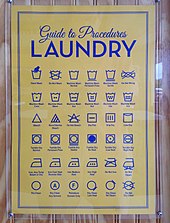
A poster from a laundromat in Beckley, West Virginia, that lists many of the common laundering instruction icons found on garment tags
A laundry symbol, as well called a care symbol, is a pictogram indicating the manufacturer's suggestions every bit to methods of washing, drying, dry out-cleaning and ironing clothing. Such symbols are written on labels, known every bit care labels or care tags, attached to habiliment to indicate how a detail item should best be cleaned. While there are internationally recognized standards for the care labels and pictograms, their exact use and form differ by region. In some standards, pictograms coexist with or are complemented by written instructions.
Standards [edit]
GINETEX, the France-based European association for cloth intendance labelling, was formed in 1963 in part to ascertain international standards for the care and labelling of textiles.[one] By the early 1970s, GINETEX was working with ISO to develop international standards for material labelling, somewhen leading to the ISO 3758 standard, Textiles – Care labelling code using symbols.[2] [three] ISO 3758 was supplemented in 1993, revised in 2005 and again in 2012 with reviews of the standard held on a five-twelvemonth cycle.[2]
In Northward America, the Standards Council of Canada in 1987 adopted Can/CGSB-86.1-M87, a colour-based cloth intendance labelling organization where green indicated "go ahead", yellow "be conscientious", and red "stop". In 2003, this organisation was withdrawn in favor of a pictogram-based organisation harmonized with North American and international standards.[4] [5] In 1996, ASTM International published a system of pictorial care instructions equally D5489 Standard Guide for Care Symbols for Care Instructions on Textile Products with revisions in 1998, 2001, 2007, 2014, and 2018.[6] [7]
Additional textile care labelling systems accept been developed for Australia, China, and Nippon.[5] Worldwide, all of these systems tend to utilise similar pictograms or labelling to convey laundry intendance instructions.[8] As of 2021[update], the pictograms are non encoded in Unicode standards, considering these symbols are not in public domain across diverse countries and are copyright.[9]
Pictograms [edit]
General [edit]
The care characterization describes the allowable handling of the garment without damaging the textile. Whether this treatment is necessary or sufficient, is not stated. A milder than specified treatment is always acceptable. The symbols are protected and their use is required to comply with the license conditions; incorrect labelling is prohibited. A bar below each symbol calls for a gentler treatment than usual and a double bar for a very gentle treatment.
Washing [edit]
A stylized washtub is shown, and the number in the tub ways the maximum wash temperature (degrees Celsius). A bar nether the tub signifies a gentler treatment in the washing machine. A double bar signifies very gentle treatment. A hand in the tub signifies that only (gentle) hand washing (not to a higher place forty °C) is allowed. A cross through washtub means that the fabric may not be done under normal household conditions. In the North American standard, dots are used to indicate the proper temperature range.
In the European standard, the level of wash agitation recommended is indicated by confined below the launder tub symbol. Absence of bar indicates a maximum agitation (cotton launder), a unmarried bar indicates medium agitation (synthetics cycle) and a double bar indicates very minimal agitation (silk/wool cycle).[10] The bar symbols too indicate the level of spin recommended with more than bars indicating lower preferred spin speed.[x]
-

Washing symbol
-

Wash at or below thirty °C (The states, 1 dot, ●)
-

Wash at or beneath twoscore °C (USA, ii dots, ●●)
-

Wash at or below 50 °C (USA, three dots, ●●●)
-

Wash at or below 60 °C (Usa, 4 dots, ●●●●)
-

Hand wash
-

Exercise not wash
Bleaching [edit]
An empty triangle (formerly lettered Cl) allows the bleaching with chlorine or not-chlorine bleach. Two oblique lines in the triangle prohibit chlorine bleaching. A crossed triangle prohibits any bleaching.
-

Bleaching symbol (allowed for both chlorine and not-chlorine bleach)
-

Bleaching with chlorine immune (obsolete)
-

Non-chlorine bleach when needed
-

Do not bleach
-

Practise not bleach
Drying [edit]
A circumvolve in the square symbolizes a clothes dryer. I dot requires drying at reduced temperature and 2 dots for normal temperature. The crossed symbol means that the wear does not tolerate machine drying. In the U.S. and Japan, in that location are other icons for natural/line drying.
Tumble drying [edit]
-

Tumble drying symbol
-

Tumble drying (low temperature)
-

Tumble drying (normal)
-

Practise not tumble dry
Natural drying [edit]
-

Drying symbol
-

Line dry
-

Dry out flat
-

Baste dry
-

Dry out in the shade
-

Line dry in the shade
-

Dry flat in shade
-

Baste dry in shade
Ironing [edit]
The fe with upwards to three dots allows for ironing. The number of dots are assigned temperatures: one prescribes 110 °C, 2 for 150 °C and three for 200 °C. An iron with a cross prohibits ironing.
-

Ironing symbol
-

Iron at low temperature
-

Fe at medium temperature
-

Iron at high temperature
-

Practice not iron
Professional cleaning [edit]
A circle identifies the possibilities of professional cleaning. A bar under the symbol ways clean gently, and two bars means very gentle cleaning.
Chemical cleaning [edit]
The messages P and F in a circle are for the different solvents used in professional dry cleaning.
-

Professional person cleaning symbol
-

Dry clean, hydrocarbon solvent only (HCS)
-

Gentle cleaning with hydrocarbon solvents
-

Very gentle cleaning with hydrocarbon solvents
-

Gentle cleaning with PCE
-

Very gentle cleaning with PCE
-

Do not dry clean
Moisture cleaning [edit]
The letter W in a circle is for professional wet cleaning.
-

Professional person wet cleaning
-

Gentle wet cleaning
-

Very gentle wet cleaning
-

Practice not wet clean
References [edit]
- ^ "Who We Are". ginetex.cyberspace. GINETEX. Retrieved 25 Apr 2021.
- ^ a b ISO 3758:2012 — Textiles — Intendance labelling code using symbols
- ^ "Japan adopts the GINETEX cloth care labelling symbols" (Printing release). International Apparel Foundation. 21 June 2016. Retrieved 25 April 2021.
- ^ "Guide to Dress and Material Care Symbols". IC.GC.ca. Office of Consumer Affairs.
- ^ a b "Care Label Recommendations" (PDF). Intertek. 2019. Retrieved 25 Apr 2021.
- ^ "ASTM D5489: Standard Guide for Care Symbols for Care Instructions on Textile Products". West Conshohocken, Pennsylvania: ASTM International. doi:10.1520/D5489-xviii. Retrieved 25 April 2021.
- ^ Ortiz, Gerald (v August 2020). "Care Tag Labels Decoded – What Do Those Laundry Symbols Mean?". Heddels . Retrieved 25 April 2021.
- ^ "Caring About the Consumers Beyond the Label" (PDF). Intertek. 2014. Retrieved twenty April 2014.
- ^ "Laundry care symbols in Word, Excel and PowerPoint". Office Watch. 25 March 2019. Retrieved 25 April 2021.
- ^ a b "Intendance Symbols". ginetex.net. GINETEX. Retrieved 2018-03-21 .
External links [edit]
- GINETEX: The International Association for Textile Care Labelling-Care Symbols
- ISO 3758:2012 — Textiles — Care labelling code using symbols
- Home Laundering Consultative Quango — What Symbols Mean
- The revised Canadian standard
- Swedish care symbols
- United States care symbols
- Further care symbols, including Japanese
- U.s.a., Japanese, and UK woven washing label symbols
- Laundry Guide to Mutual Care Symbols — Cloth Industry Affairs
- Guide to Common Dwelling house Laundering & Drycleaning Symbols — Textile Industry Diplomacy

Source: https://en.wikipedia.org/wiki/Laundry_symbol
Posted by: pickenselly1966.blogspot.com
0 Response to "Can I Use Laundry Bleach To Clean My Floors"
Post a Comment